Burnout arrived at a moment when high-functioning, capable people were quietly reaching the edge of their capacity and did not yet have language for what was happening inside their bodies. Emily Nagoski, a sex educator and researcher known for translating complex physiology into accessible frameworks, and Amelia Nagoski, a conductor with deep insight into performance pressure and emotional expression, combined disciplines to address a shared problem.
Rather than focusing on productivity or mindset alone, the book offered something that felt new to many readers: a clear explanation of how stress lives in the body, how it accumulates over time, and why insight alone does not resolve it. This body-based orientation, paired with cultural critique and narrative storytelling, is a key reason the book has been widely referenced by therapists, physicians, coaches, and high-achieving professionals.
What Terrain This Book Covers
This book explores the lived experience of chronic stress through a physiological lens. Instead of asking readers to simply manage their circumstances better, the book circles a different set of questions.
What happens inside the nervous system when stress is never fully resolved?
Why capable, motivated people still feel depleted despite doing everything “right”?
How cultural expectations shape who absorbs stress and who is allowed rest?
The book is primarily educational and explanatory, with a conversational narrative style. It blends neuroscience, psychology, and cultural analysis with stories and metaphors that help readers recognize patterns they may already feel but have not named.
At its core, this book is less about changing your life and more about understanding why your body responds the way it does to sustained pressure.

This Book Might Be Especially Useful If You're Someone Who...
You may find yourself drawn to this book if you are in an early to middle stage of curiosity, where something feels off but you are not yet trying to fix yourself.
This book might be useful if you are someone who:
- functions well on the outside but feels chronically tense, tired, or emotionally flat
- prefers understanding patterns over being told what to do
- is intellectually curious and wants the science behind stress responses
- feels skeptical of self-help but still wants a framework that makes sense
- has noticed that rest does not always restore you the way it “should”
- has spent years taking care of others and quietly absorbing pressure
- wants language for invisible labor without turning it into blame
Many readers who resonate with this book are not in crisis. They are competent, thoughtful, and exhausted, and they are looking for an explanation that respects their intelligence.

Questions This Book Can Help You Sit With
This book does not promise answers as much as it offers better questions.
It may be helpful if you find yourself wondering:
- Why does my body still feel on edge even when things are technically fine?
- Is this exhaustion personal, or is it patterned?
- What happens to stress that never gets completed
- Why do some forms of self-care feel ineffective or even irritating?
- How much of my depletion is cultural rather than individual failure?
For many readers, these questions alone reduce shame. They reframe burnout not as weakness, but as a nervous system doing exactly what it was designed to do under prolonged pressure.

How This Book Is Often Used by Readers
Most readers do not move through Burnout quickly. It tends to be read in pieces, often with pauses to reflect or notice bodily responses.
Common patterns include:
- reading a chapter, then setting the book down for days
- returning to specific sections about the stress cycle
- sharing language from the book with partners or colleagues
- using it as a reference rather than a linear program
It is often read alone, but its ideas frequently surface later in conversation. Not because it gives scripts, but because it gives shared language.

If You've Read These Books, This One Might Feel Familiar (With Some Key Differences)
Readers familiar with other well-known titles may notice overlapping themes.


Why Zebras Don’t Get Ulcers, Third Edition by Robert M. Sapolsky
Similar scientific grounding. Burnout leans more relational and cultural, with practical framing for everyday life.

Atomic Habits: An Easy & Proven Way to Build Good Habits & Break Bad Ones by James Clear
Where habit books emphasize behavior change, Burnout focuses on completion and regulation rather than optimization.
This book explains why more than how, which is often exactly what some readers need first.
A Gentle Note to My Readers
I wanted to start with this book because it does a wonderful job of lowering the barrier to entry. It makes the scary work of self-examination feel accessible, human, and even funny.
However, as you read, I invite you to hold a gentle curiosity about the difference between insight and experience.
In the book, you’ll encounter a concept called “the booby prize of therapy,” which is the idea that simply knowing why you do what you do isn’t enough to change it. You can read every book on this list and become an expert on your own patterns, but healing (whether individual or relational) is rarely a solitary intellectual pursuit. We often grow best in connection with others, where we can be seen and heard in real time.
It’s also worth noting that because the author comes from a television background, the stories here have a certain “tidiness” to them. Real growth is often slower, quieter, and less linear than a chapter in a book. Additionally, you may notice the author’s internal monologue regarding her patients can sometimes feel sharp or critical. If this brings up a fear that a therapist might judge you, I encourage you to view it as an honest admission of “countertransference” (the therapist’s own internal reaction), which is something we’re trained to manage and work through for you, not against you.
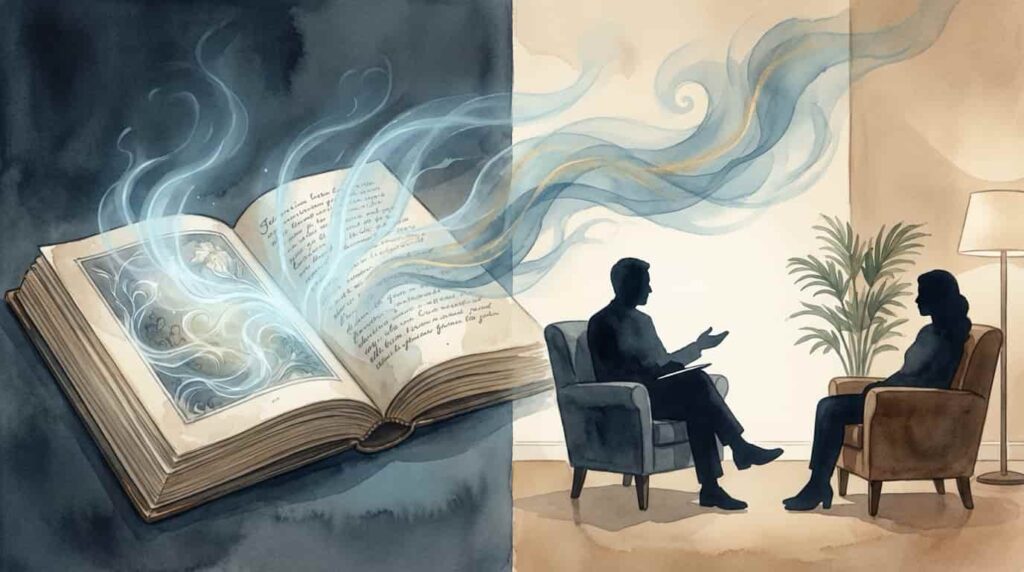
If you find yourself identifying deeply with the stories in these pages, just know that reading about the therapeutic process is quite different from experiencing the safe, collaborative space of a therapeutic relationship yourself. The book is a map, but the therapy room is the terrain.
What Comes Next?
If this orientation resonated with you, Maybe You Should Talk to Someone might be a supportive place to start exploring your inner world and the patterns that show up in your relationships.
Take your time with it. There’s no rush to “fix” anything. I’ll be back soon with another entry in the Let’s Just Start Here reading list, covering a different angle of personal growth and relationship development. Until then, take good care.