The Empty Well
Leo comes home from work already exhausted. His job has taken everything he has, and without quite noticing, he turns toward his partner, Maya, hoping she’ll refill him. He wants her energy to lift his mood, her attention to soothe his stress, her love to undo the weight of the day.
But Maya is tired too. When she can’t offer that emotional rescue, Leo feels hurt and resentful. A quiet story begins to form in his mind: If she loved me enough, she’d make me feel better.
What’s really happening is more subtle—and more common—than most couples realize. Leo has handed responsibility for his internal emotional state to his partner. He’s showing up to the relationship emotionally under-resourced, asking it to meet needs that actually belong to his own inner life.
Many couples get stuck here because we’re raised on the myth of the Magical Other—the idea that a soulmate is supposed to heal our wounds, regulate our feelings, and complete us. When that fantasy collides with real human limits, disappointment and resentment are almost inevitable.

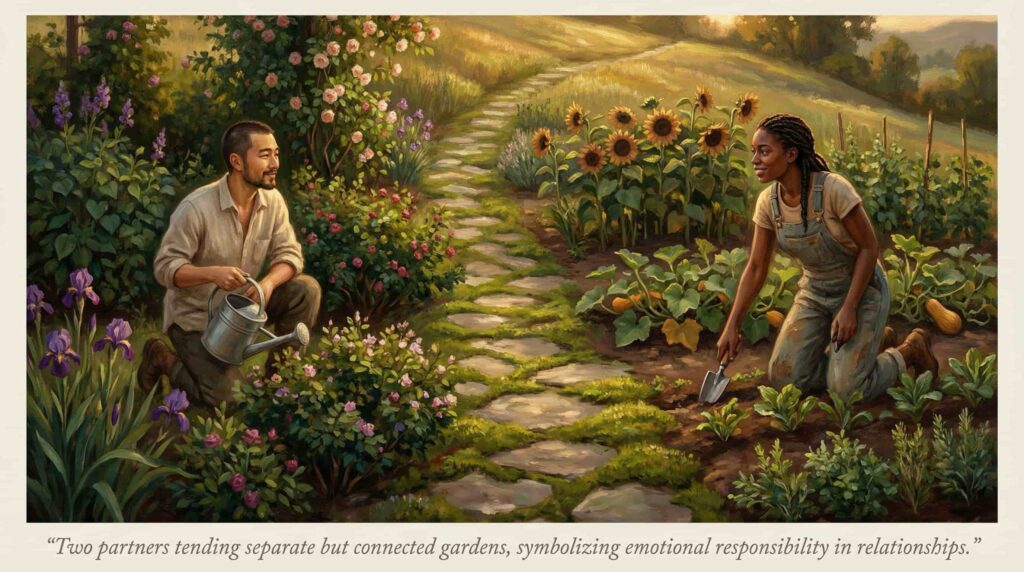
“You have two gardens: your own garden and that of your beloved. First, you have to take care of your own garden and master the art of gardening. In each one of us there are flowers and garbage. The garbage is the anger, fear, discrimination, and jealousy within us. If you water the garbage, you will strengthen the negative seeds. If you water the flowers of compassion, understanding, and love, you will strengthen the positive seeds. What you grow is up to you. If you don’t know how to practice selective watering in your own garden, then you won’t have enough wisdom to help water the flowers in the garden of your beloved.”
Source: Thich Nhat Hanh, Fidelity: How to Create a Loving Relationship That Lasts, Chapter 9
The Inspiration: Two Gardens, Not One Shared Plot
A more sustainable model of love begins with a simple but radical idea: each partner has their own inner garden to tend.
Inside every person are emotional “seeds”—some nourishing, like compassion, patience, and joy; others painful, like fear, anger, jealousy, and old hurt. These seeds grow based on where we place our attention. When we ignore our inner life or expect someone else to manage it for us, the more reactive patterns tend to take over.
This teaching, articulated beautifully by Thich Nhat Hanh, reframes love not as emotional fusion, but as interdependence. Caring for your own inner world isn’t selfish—it’s what allows you to meet your partner without burdening them with emotional labor they were never meant to carry.
When you know how to tend your own garden, you bring discernment, steadiness, and generosity into the shared space of the relationship. Without that skill, even the most loving intentions can turn into pressure, dependency, or blame.
The Practice: Tending Your Inner Garden First
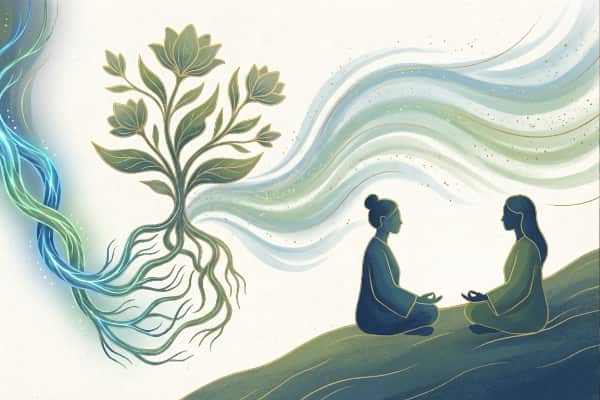
Today’s practice is about full accountability—with kindness.
Before engaging with your partner, spend at least 15 minutes tending your own internal state. This is time to regulate, not perform.
You might:
- Sit quietly and name what you’re feeling without trying to change it
- Take a slow shower or bath as a mindfulness practice
- Journal honestly about stress, irritation, or sadness
- Step outside and breathe with intention
The goal is not to eliminate feelings—it’s to stop outsourcing their regulation. This is what it means to “take a bath in mindfulness.” When you enter the relationship afterward, you arrive with inner abundance rather than emotional hunger. You’re offering presence instead of need.
Why This Works: Emotional Sovereignty Builds Safer Love
Both contemplative traditions and modern psychology agree on a core truth: relationships function best when two people take responsibility for their inner world.
Mindfulness practitioners describe this as avoiding the “trance of unworthiness”—the belief that our happiness depends on someone else’s behavior. When we fall into that trance, love quietly turns into a performance evaluation.
Therapists describe the same shift using the language of healthy differentiation and release from codependency. Differentiation means staying emotionally connected without collapsing into dependence. It’s the difference between “I need you to fix me” and “I can take care of myself and still want to be close to you.”
Science strongly supports this approach:
- Self-compassion and nervous system regulation increase vagal tone, improving emotional regulation and relational engagement (Sharon Salzberg, Real Love)
- Oxytocin, released during self-care and emotional attunement, calms the stress response and increases resilience during conflict
- Emotional contagion research shows that regulated nervous systems influence others at a physiological level—calm literally spreads (Sharon Salzberg & Robert Thurman, Love Your Enemies).
- Long-term studies demonstrate that high-quality relationships, sustained by emotionally self-responsible individuals, are associated with a 50% increased likelihood of longevity.
When you tend your own garden, you don’t withdraw from love—you stabilize it. Emotional sovereignty isn’t distance. It’s the foundation that makes intimacy safe.
This daily practice is for couples who want something steady and human to return to. Drawing from mindfulness, Buddhist teachings, modern therapy, and science, it offers one small practice each day to support presence, emotional safety, and connection over time. I hope you find it useful. Enjoy!!!