
The Internal Debater
Ken and Sophie are talking about household responsibilities. Sophie tries to explain how overwhelmed she feels, but Ken isn’t really listening. He’s scanning her words for inaccuracies, rehearsing his counterpoints, and preparing evidence to prove she’s wrong.
Every few minutes, he interrupts to correct her memory or defend his effort. What could have been a moment of closeness slowly turns into a courtroom cross-examination.
By the end of the conversation, Sophie feels unseen. Ken feels frustrated. Neither feels understood.
This dynamic is incredibly common. Many couples unknowingly replace listening with strategizing. Instead of meeting each other as full human beings, they slip into what philosophers call an “I–It” stance — relating to the other person as a problem to solve, a position to defeat, or a task to manage. Over time, this pattern erodes trust and creates emotional distance, even when both partners care deeply.

“You have two gardens: your own garden and that of your beloved. First, you have to take care of your own garden and master the art of gardening. In each one of us there are flowers and garbage. The garbage is the anger, fear, discrimination, and jealousy within us. If you water the garbage, you will strengthen the negative seeds. If you water the flowers of compassion, understanding, and love, you will strengthen the positive seeds. What you grow is up to you. If you don’t know how to practice selective watering in your own garden, then you won’t have enough wisdom to help water the flowers in the garden of your beloved.”
Source: Thich Nhat Hanh, Fidelity: How to Create a Loving Relationship That Lasts, Chapter 9
The Inspiration: Two Gardens, Not One Shared Plot
At the heart of deep listening is a radical shift in intention. Instead of listening to evaluate, fix, or rebut, you listen to relieve suffering.
This idea comes from the work of Thich Nhat Hanh, who framed listening as a form of compassion in action. From this perspective, the purpose of listening isn’t accuracy — it’s presence. It’s allowing another person to fully express what they are carrying without interruption, judgment, or premature clarification.
When people are allowed to speak without being corrected, something powerful happens: tension releases. Emotions move. The nervous system settles. Often, insight emerges on its own — without the listener having to say a single “helpful” thing.
This kind of listening requires humility. It asks us to set aside our need to be right and trust that understanding comes after safety, not before it.
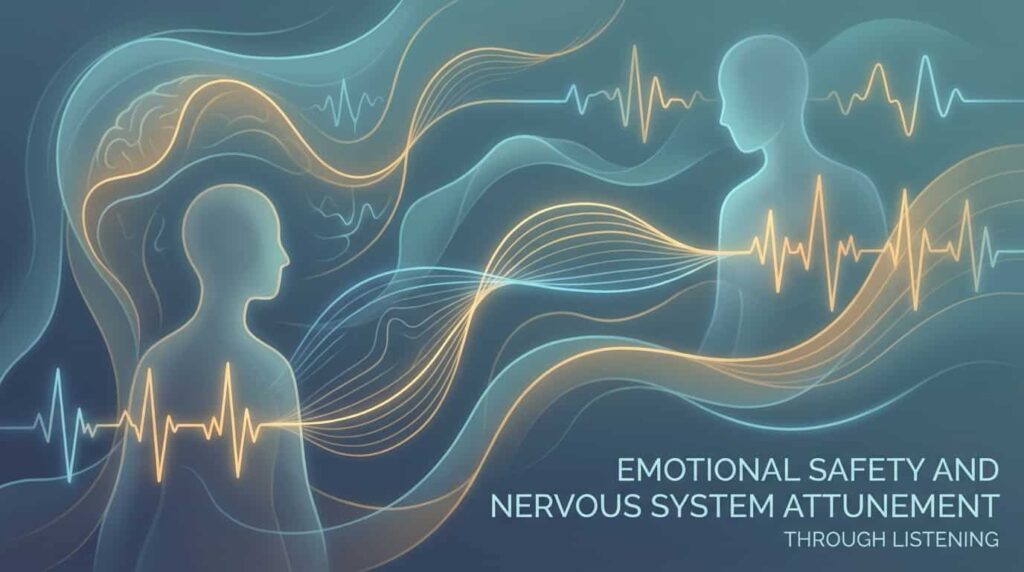
The Practice: Offering Deep Listening as Medicine
Today, offer your partner 10 uninterrupted minutes of Deep Listening.
Your only job is this: listen to help them suffer less
Guidelines for the practice:
- Do not interrupt
- Do not offer advice
- Do not correct their perceptions — even if they’re inaccurate
- Maintain gentle eye contact or a soft, grounded posture
- If defensiveness arises, return to your breath
Silently remind yourself:
“I am listening so they can empty their heart. Clarifications can wait.”
This is not passive listening. It’s active restraint — choosing presence over performance, care over control.
Why This Works: Safety Before Solutions
From both contemplative and clinical perspectives, deep listening creates emotional safety — the single most reliable predictor of relationship health.
Relational therapists consistently find that when partners feel safe enough to be vulnerable without being critiqued, cycles of defensiveness and withdrawal begin to dissolve. This is the shift from a transactional mindset (“Who’s right?”) to what philosopher Martin Buber described as an “I–Thou” relationship — a meeting between two subjects, not a debate between positions.
Mindfulness traditions describe a parallel process. When someone is listened to without judgment, their internal emotional knots — sometimes called internal formations — are given space to loosen. Pain that is met with presence transforms more easily than pain that is resisted.
The science strongly supports this:
- Mirror neurons allow us to resonate with another person’s emotional state through embodied simulation, not analysis (Sharon Salzberg & Robert Thurman, Love Your Enemies)
- Vagal tone and auditory attunement improve when we deeply attend to another’s voice, physically enhancing our ability to hear and connect (Sharon Salzberg, Real Love).
- Oxytocin release during moments of attuned listening increases trust and downregulates the stress response.
- Research on emodiversity shows that allowing space for difficult emotions is associated with better physical health outcomes
- (Sharon Salzberg, Real Love).
- Long-term studies demonstrate that relationships characterized by responsive, empathetic listening predict up to a 50% increased likelihood of longevity.
Deep listening doesn’t just improve communication. It rewires how safe love feels in the body.
This daily practice is for couples who want something steady and human to return to. Drawing from mindfulness, Buddhist teachings, modern therapy, and science, it offers one small practice each day to support presence, emotional safety, and connection over time. I hope you find it useful. Enjoy!!!