
When Criticism Becomes the Default
Maria and Tom are good people in a committed partnership, but their conversation has drifted toward complaint and away from appreciation.
Maria notices Tom’s socks on the floor but rarely comments on how his humor eases her stress;
Tom notices Maria’s sharp tone more than her warmth toward him.
Their relationship feels like a garden overgrown with weeds — criticism crowding out the flowers of joy — simply because their brains, wired to spot threats and problems, have taken the lead.
This survival instinct makes it easy to point out what’s wrong and easy to forget what’s right.

“The practice of selective watering allows the positive seeds in us to grow… the good seeds of compassion, joy, and understanding… blossom… you are watering her self-confidence and she will become the source of her own happiness as well as yours.”
Source: Thich Nhat Hanh, Fidelity: How to Create a Loving Relationship That Lasts
The Inspiration: Why We Need to Notice the Good
Seeing the Seeds That Want to Bloom
Imagine a practice that doesn’t ignore conflict but simply shifts our lens for a moment — toward what’s alive and positive in our partner.
This isn’t flattery — it’s recognizing genuine qualities your partner already embodies.
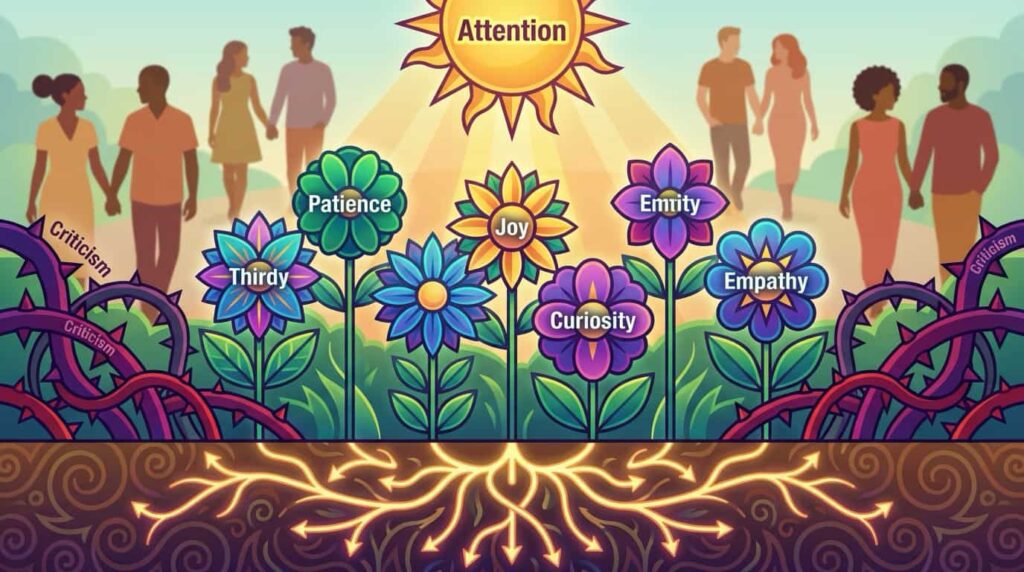
The Practice: Water Three Flowers Today
Noticing and Naming What’s Alive
Today, pick three specific qualities or actions in your partner that you genuinely appreciate — the small, concrete things that build connection when they are named. Then tell them, in your own voice, what you noticed:
“I really appreciated the patience you showed with the kids this morning.”
“When you made coffee and didn’t rush me, it made me feel cared for.”
Speak the truth simply — no puffery, no agenda — just attention and honest appreciation. The intention is to nourish your partner’s heart and build a “reservoir” of positive shared memories you can draw from when times are harder.
Why This Works: The Science and Relational Logic
Attention Shapes What Grows
Relational attention matters. Psychological science shows that how partners respond to each other’s positive qualities or good news is a better predictor of long-term relationship satisfaction than how they handle conflict or negative events. Partners who practice what is called Active Constructive Responding — showing genuine engagement when their partner shares something good — build emotional safety and trust over time.
Neurobiology supports this too. Shared moments of warmth and appreciative attention create positivity resonance, which has measurable associations with:
- higher flourishing mental health
- fewer loneliness and illness symptoms
- stronger social bonds and trust
- increased oxytocin release (the “bonding hormone”)
- improved vagal tone — the physical index of how well the body regulates stress and inflammation.
These biological processes aren’t fairy tale metaphors — they are real, measurable effects that make us calmer, more resilient, and more connected.
And over the long term? Couples who sustain high relational satisfaction — the kind that comes from frequent positive connection — show greater life satisfaction, better mental health, and more stable commitment over years compared to couples with persistent dissatisfaction.
This fits with both ancient contemplative teachers and modern relational science: attention is a force. What we habitually water — whether gratitude or complaint — gets stronger.
This daily practice is for couples who want something steady and human to return to. Drawing from mindfulness, Buddhist teachings, modern therapy, and science, it offers one small practice each day to support presence, emotional safety, and connection over time. I hope you find it useful. Enjoy!!!